Why AI Audiobook Narrators Change Voice Mid-Chapter (and How We Fix It)
Alek Karp
Co-founder
Share this article
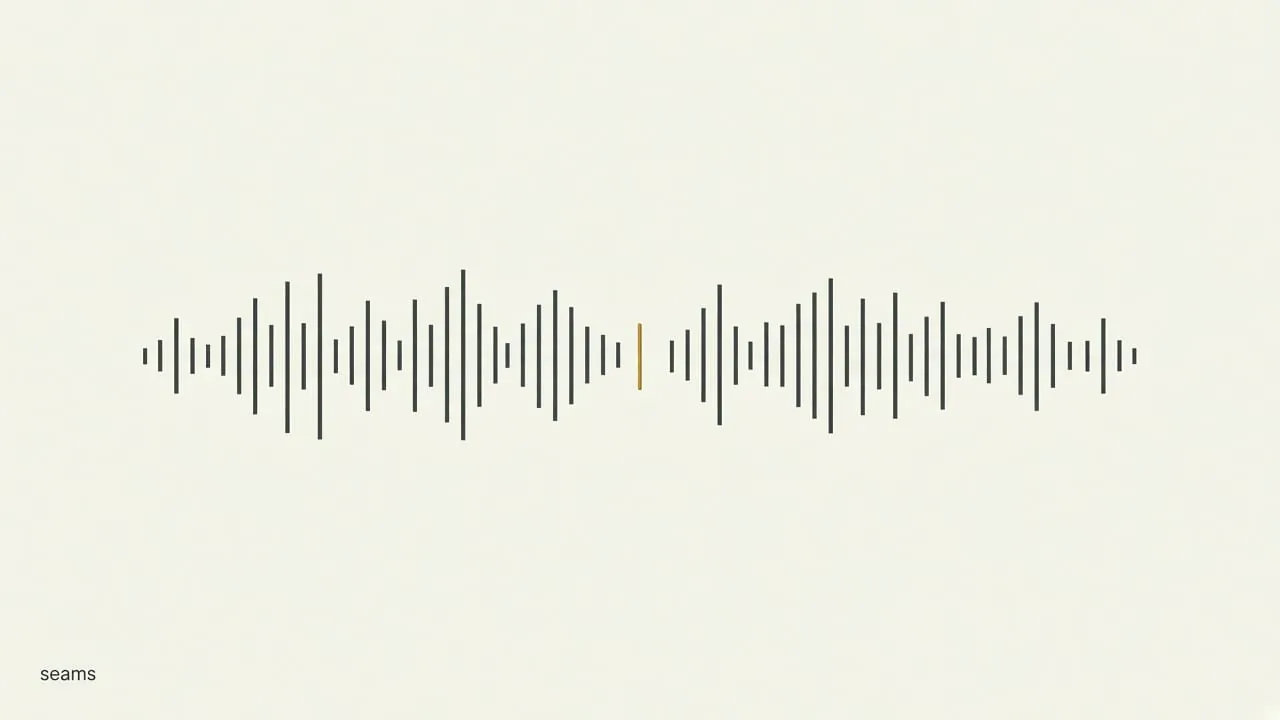
AI narrators drift between takes, creating "seams" where the voice changes. What causes TTS drift, how to measure it, and how Lex engineers around it.
Play any long AI-narrated audiobook and sooner or later you hit it. The narrator finishes a paragraph, starts the next one, and sounds like a slightly different person. Same voice on paper. But the pitch moved and the energy reset. We call these moments seams, and after months of producing scored audiobooks at Lex, we consider them the hardest quality problem in AI audio.
This post covers what causes seams and the pipeline we built to measure and remove them. It ends with how to test a voice yourself before you commit a book to it.
Key numbers: listeners start noticing a pitch jump around 20 Hz. Raw chunk joins in our tests drifted 30–48 Hz (more than a semitone for a typical speaking voice). With request stitching plus our take-selection pipeline, every join held within 15 Hz and most landed in single digits.
Every chunk is a cold start
Text-to-speech APIs cap the amount of text per request. Google Cloud's Text-to-Speech request limits allow 5,000 bytes, and OpenAI's speech endpoint takes 4,096 characters (both checked October 2026). A 20-minute chapter runs past 15,000 characters, so producing one means five to ten separate requests joined into a single file.
Most current TTS models are stateless. A request knows nothing about the audio generated before it. Each request starts a new performance, and the model improvises the narrator's register from scratch. Two improvisations rarely land in the same place.
The drift is measurable. We check every join by comparing speech level and median pitch in a four-second window on each side. On a typical narrator, a pitch jump above about 20 Hz is where listeners start to notice. Raw chunk joins, with no mitigation, gave us jumps of 30 to 48 Hz in our tests. A semitone is about 6% of pitch, so for a typical speaking voice that is more than a full semitone. The narrator is changing key in the middle of a paragraph.
What actually reduces seams
Practice lead-ins
Each chunk after the first is rendered with the previous chunk's last two sentences prepended. The model reads them, settles into the voice, then reaches the text we keep. The practice audio is trimmed off afterward using the word-level alignment. This removes the worst cold-start artifact, where the first line after a join comes in harsh.
Multiple takes, scored for continuity
For chunks that sit against a seam we render up to three takes and score each against the audio it has to follow, using the same level and pitch measurements as our QA. The closest take wins. This step does the most work in the stack. A take that lands 40 Hz hot costs nothing if another take landed at 5.
Level matching
Every take rolls its own overall loudness. Before joining, the incoming take is gain-adjusted to match the speech level of the audio before it. Two dB of mismatch reads as an edit. Corrected, it reads as a sentence break.
Room tone instead of crossfades
Crossfading two vocal takes smears them together and sounds like what it is. We butt-join across a 380 ms pause instead, and we fill that pause with room tone extracted from the incoming take. Pure digital silence between two voiced takes is audible as a hole in the recording. Room tone reads as a breath.
Surgical splices
After the render, a QA pass scans every join. Anything still flagged gets fixed in isolation. We re-render just the offending passage, sandwiched between its surrounding sentences so the model performs it in context. The most continuous of several takes gets spliced in. The rest of the chapter is untouched.
Request stitching
Some models support request stitching. You pass the previous chunk's text and request IDs with each call, and the model conditions its new take on what came before. We ran the same chapter both ways. Without stitching, joins drifted up to 48 Hz. With it, every join held within 15 Hz and most were in single digits, below the threshold where anyone notices.
The complication, as of mid-2026, is that the newest and most expressive models do not support stitching yet, while the models that stitch read flatter. So we render the base narration on a stitching model for continuity, and splice in the expressive model line by line where a delivery needs it, like a whispered prophecy or an urgent aside. Two models, one narrator.
Measure it, because your ears adapt
You cannot QA seams by listening alone. By the third chapter of a session you stop hearing drift that a fresh listener notices immediately. Every join in every chapter we ship goes through the same objective gate, and the seam map is stored alongside the audio so later edits know where the fragile points are.
AI narration does not get to skip the discipline of measuring.
How Do You Test a Voice for Seams Before You Commit?
Every gate above runs after the render. The cheaper check runs before you cast a narrator at all.
A voice demo is one short request, so it never contains a seam. It tells you how a voice sounds and nothing about whether it holds its register across the five to ten requests a chapter needs. To see that, you have to force the cold start yourself.
Take one sentence from your book and render it three times as independent requests. Pick a line that sounds like the book, with the pacing and punctuation your chapters actually use. Same voice, same text. Then compare the median pitch of the three renders. The spread shows how far the voice wanders each time it starts over. This is the cold-start probe for voices we run before casting.
Read the spread against these thresholds. Under 3%, the register is locked, and joins will be inaudible. At 3 to 5%, the voice is workable, and production mitigations absorb it. Over 10%, you will hear the voice change at every seam, and no pipeline will save it. For scale, 6% is one musical semitone.
A probe costs three short renders per voice, so run it on every voice on your shortlist. Then hear the survivor across real joins. Our free first-chapter demo gives you a finished first-chapter demo within 24 hours, free.
How Do You Keep Names and Pronunciation Consistent Across Chapters?
Pitch is the seam you can measure. A seam can also be a name read two ways in two chapters. Each request decides pronunciation on its own, so the invented name a model gets right in chapter two can come out differently in chapter nine.
The fix starts in your manuscript notes. For invented names and tough proper nouns, add a phonetic line. You don't need IPA. A simple phonetic hint in a separate list is enough. Write each hint the way you would say the name to a friend over the phone. Our manuscript pronunciation list guide shows how to set one up.
That list is what the producer works from. At Lex, a producer checks names and pronunciation against the manuscript and retakes any line that misses, before an author hears a word. Your ears adapt to a wrong name the same way they adapt to drift, so the list does the job a fresh listener would.
Lex produces fully scored AI audiobooks, with narration, music, ambience and sound effects, for classic literature and original works. Hear finished productions on our audio showcase or in the free app.
Frequently Asked Questions
What is the difference between voice consistency and voice cloning?
Cloning makes the voice. Consistency is whether that voice lands in the same register on every request. A clone can still drift at every join, so the source matters: voices cloned from professional studio narration are far more stable than character voices. At Lex, a cloned voice is a private model used only for its book.
Why don't AI voice demos show how a voice holds up on a full book?
A demo is one short request, so it has no joins. A 20-minute chapter runs five to ten requests, and every join is a fresh cold start where the register can move. To see how a voice holds up, run the three-take probe on a sentence from your own text and compare median pitch.
Can I switch AI voice tools mid-project without losing voice consistency?
Switching models means a new register at the switch point, because each model improvises its own. If you must mix models, measure every join the way this post describes. Splice the second model in line by line, so every switch is a short join you can check and retake.
Which AI audiobook tools produce ACX-compliant audio?
On ACX, policy decides before file specs do. ACX self-serve still expects human narration. ACX does not accept externally produced AI narration. Audible on the Publisher pack goes under Lex's publisher agreement: a direct Lex upload, not a separate ACX project. For every other store, see where AI narration sells.
Hear your first chapter free
Send the manuscript. We cast, direct, and score the opening and send it back in about a day. No card, yours to keep.
More to read

YouTube Is Reportedly Adding Audiobooks in 2027: What It Means for Indie Authors
The WSJ reports YouTube is in talks with publishers to add audiobooks to Premium as soon as 2027. What we know, what is unconfirmed, and how indie authors should prepare.

Spotify Audiobooks Go Global: How Indie Authors Get Into 180+ Markets
Spotify is taking audiobooks from 22 markets to 180+ by the end of 2026. What changed, how your title gets listed, how the per-market pool pays, and a checklist.