How to Price Your Audiobook in 2026: A Guide by Length, Store, and Library
David Mainayar
Founder
Share this article
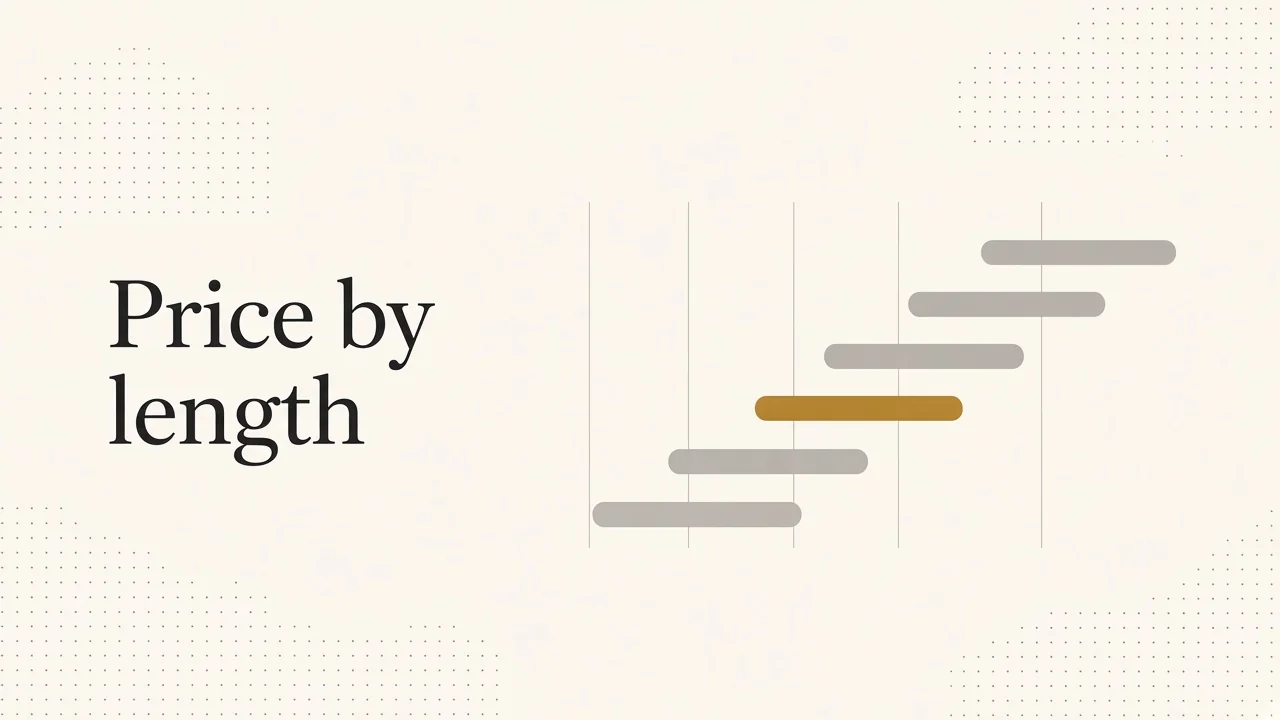
Audible's current price ranges by runtime, the list price to set everywhere else, how to price the library edition, and what each store pays per sale.
Pricing an audiobook takes about four seconds: one metadata field, one number, done. It deserves a little more thought than that, though not a lot. Audiobook pricing comes down to three things: how long the finished book runs, which stores let you set the price at all, and what you want this edition to do for you.
This post is about the price listeners pay. If you're working out what it costs to make the audiobook, that's a different post.
Key numbers: a finished hour is about 9,300 words, so a 75,000-word novel runs about 8 hours. Audible sets its own price; for 5 to 10 hours, its published range is $11.15 to $20.65. Where you set the list price yourself, Spotify's guidance for 6 to 10 hours is $15 to $25. Library editions are priced at retail or up to 3 times retail. Spotify for Authors pays 50% of the price you set on each à la carte sale.
How long is your audiobook?
Audiobooks are priced by finished length, so get the runtime first. The rule of thumb is about 9,300 words per finished hour: a 75,000-word novel runs about 8 hours, and a 120,000-word fantasy about 13.
Plan with the rule, but price from the files. For an 85,600-word novel we finished in August, the rule of thumb said about 9 hours 12 minutes. It came in at 9 hours 58 minutes. Pacing, dialogue, and scene breaks all move the number.
That book also landed about 90 seconds under 10 hours, the line where Audible's next range starts. We didn't pad it, and you shouldn't either. Stretching a read to cross a band line is the one pricing trick listeners can hear.
What will Audible charge for it?
Audible sets the price, not you. ACX publishes the ranges Audible's prices have fallen in by runtime, and they're the same for exclusive and non-exclusive titles. Runtime is the main input; Audible says genre and other factors count too.
You'll still see older, rounder ranges quoted online, like $15 to $25 for 5 to 10 hours. They don't match ACX's current help page, so don't plan around them.
Audible's new royalty model, open to every ACX creator since May 26, 2026, changed two things about price:
- You can suggest one. It's optional, and you can change it once every 24 hours. Audible still decides, and says it may sell lower during a promotion or to match another retailer's price for your title.
- Price now splits membership money. Each member's monthly value is divided among the titles they listened to, in proportion to each title's à la carte price, then multiplied by your royalty rate. A higher Audible price earns a bigger slice.
The same model raised ACX royalty rates to 50% exclusive (exclusive now covers Audible, Amazon, and Apple Books) and 30% non-exclusive, up from 40% and 25%. Titles still on the legacy model have until the end of 2026 to move or leave. AI-narrated books reach Audible through a wide distributor rather than ACX, and Audible sets the price on those too.
What list price should you set everywhere else?
On Spotify, Apple Books, Google Play, Kobo, and the library platforms, you (or your distributor) set the list price. Spotify for Authors publishes the clearest guide, and its ranges overlap on purpose:
| Finished length | Suggested list price |
|---|---|
| Under 1 hour | $4 to $7 |
| 1 to 3 hours | $7 to $12 |
| 3 to 6 hours | $10 to $15 |
| 6 to 10 hours | $15 to $25 |
| 10 to 15 hours | $17.50 to $25 |
| 15 to 20 hours | $20 to $30 |
| Over 20 hours | $25 to $40 |
Those run higher than Audible's ranges, and that makes sense: Audible's numbers are what it actually charged, while a list price is the number stores discount from. Google, for one, keeps paying you on list even when it discounts the title.
To choose a spot inside the band:
- Check five comparable titles. Same genre, about the same length, from authors at your stage rather than this year's celebrity memoir. Note what they cost on Audible and on Apple or Google.
- Decide what this edition is for. Spotify's guide frames it as revenue per sale versus exposure. A first audiobook or a series opener earns its keep in reach; a book with readers already waiting for the audio can ask for more.
- Use one list price everywhere. Audible says it may lower your price to match another retailer, so a cheaper listing on one store can drag your Audible price down with it.
Which stores actually pay on your price?
Fewer than you'd expect. Audible sets its own price, and subscription services pay for time listened, so the number you type mostly governs the stores where someone buys one book with cash. Here's what a single sale pays on a ten-hour novel listed at $14.99, with a $29.99 library price, before any distributor's share:
| Store | Your payout is based on | One sale |
|---|---|---|
| Spotify, à la carte | 50% of the price you set, whatever Spotify charges | $7.50 |
| Google Play Books | 52% of list, even when Google discounts | $7.79 |
| Apple Books | 45% of list | $6.75 |
| Kobo | 45% of list at $2.99 and up | $6.75 |
| Chirp | 45% of the deal price | Varies by deal |
| Audible | 30% of Audible's price, non-exclusive | Audible sets the price |
| Spotify Premium, Storytel, Everand, Kobo Plus | A share of a monthly pool, by time listened | Not tied to price |
| OverDrive / Libby | 45% of the library price, per copy a library buys | $13.50 per copy |
So your list price is a lever on the cash stores and the library edition, and not much else. A lower list price doesn't shrink what subscription services pay, and Audible has the final word on its own price. On the Lex path, Lex keeps nothing; the partner's share and what reaches you on every store are in our store-by-store royalty table.
How should you price the library edition?
Give it its own price, at or above retail. Library platforms ask for a separate number because one library copy gets lent again and again. Spotify's guide says a library price often equals retail or runs 2 to 3 times retail, with 2.5 times the common multiplier.
The number matters most on OverDrive, where a library buys a copy that one patron borrows at a time, and OverDrive's supplier terms pay 45% of the price you set. At $29.99, that's $13.50 each time a library adds a copy. Hoopla works differently: the library pays each time a patron borrows, and you get a share of that fee.
Our default is twice retail, so a $9.99 audiobook goes to libraries at $19.99.
What price do we suggest for a ten-hour novel?
When Lex publishes a book, we fill in the retail and library prices on the metadata sheet, and the author approves them before anything goes live. For a ten-hour indie novel, our starting point is $9.99 to $14.99 retail and twice that for libraries. The same retail price usually goes on the Lex Store.
That's at or below the low end of the guidance above, on purpose:
- Audible prices its own copy. The number on our sheet mostly governs the cash stores, where a listener weighs it against your ebook.
- Subscriptions pay for listening, not price. A lower list price costs nothing on Spotify Premium, Storytel, Everand, or Kobo Plus.
- A new audiobook has no audio reviews yet. Early listeners are taking a chance on a narrator they haven't heard. Make the first purchase easy, then raise the price once reviews come in.
Price toward the middle of the band instead when readers are already asking for the audio, or for a later book in a series whose first book is the cheaper way in.
Your pricing checklist
- Get the runtime from the finished files, not from a word count.
- Look up Audible's range for that runtime. On ACX, suggest a price inside it. Through any other route, Audible decides.
- Set one list price for every other store from the band: low end for a first audiobook or a series opener, middle for a book with readers waiting.
- Set the library price anywhere from retail to 3 times retail. Ours is twice retail.
- Match it on your own site, so no retailer has a lower price to match.
- Don't pad the runtime to reach the next band.
- Revisit once reviews arrive. ACX lets you change a suggested price once every 24 hours, and Voices by INaudio (formerly Findaway Voices) tells authors to change list prices and experiment.
Sources
- ACX, Suggested price: Audible's ranges by runtime, price matching, and how price splits membership value
- ACX, Audible's new royalty model: royalty rates and the legacy model's end date
- Spotify for Authors, Metadata and Asset Guide: list and library price guidance, updated November 2024
- Spotify for Authors, distribution terms: à la carte and Premium payouts
- Findaway Voices, Audiobook list price
- OverDrive, Summary of terms for audiobook suppliers
- Google Play, Apple Books, Kobo, and Chirp rates, with links to each store's terms: our royalty table
Price it once you've heard it. Send your manuscript and get the first chapter performed free at lex.audio/first-chapter. When you publish with Lex, we fill in the pricing on the metadata sheet and send it to you to approve. Here's how publishing works.
Hear your first chapter free
Send the manuscript. We cast, direct, and score the opening and send it back in about a day. No card, yours to keep.
More to read
How to remove your Virtual Voice audiobook from Audible
Remove a KDP Virtual Voice audiobook through KDP, not ACX, and why KDP Select audio exclusivity still runs until the current term ends.
Twenty Seconds Is Enough: What Our Best Author Voice Clones Were Recorded On
Four author clones, input and output. The 20-second clip each author sent, the clone reading their book, and the recording rules that held.