PDF to Audiobook AI: How to Turn Your Book Into an Audiobook Stores Will Sell
Alek Karp
Co-founder
Share this article
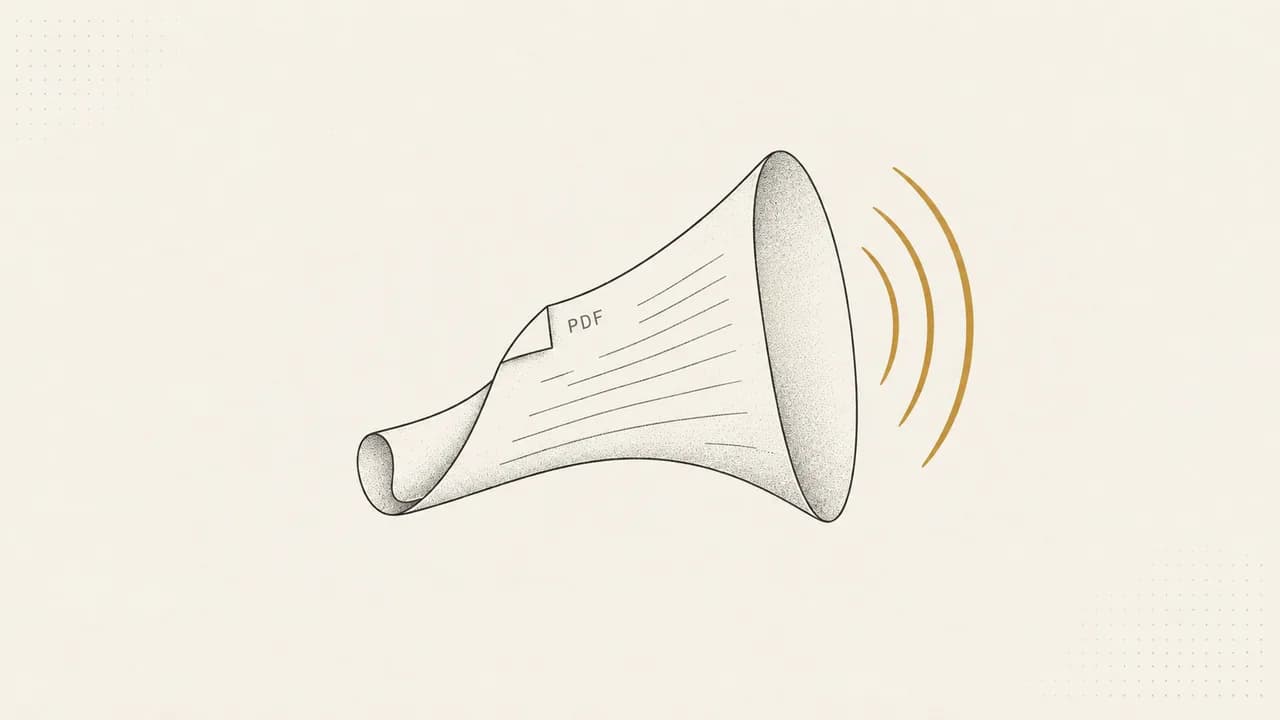
PDF to audiobook AI turns your book into audio, but stores need clean chapter files, retailer specs and AI disclosure. Here is how to get there.
Most PDF to audiobook AI tools are built for personal listening: upload a file, get an MP3, play it on the commute. An author with a finished PDF or ebook wants something else, a retail product that stores accept and listeners finish. Listed is not the same as listened to.
The market rewards getting this right. US audiobook sales reached $2.43 billion in 2025, 9% over the previous year, according to the APA 2026 survey results from the Audio Publishers Association. The same survey puts AI at .03% of 2025 sales revenue, and only 16% of listeners have heard an AI-voiced audiobook.
Listeners are still deciding about AI narration, so quality and honest disclosure carry the sale. This guide covers what a generator does to your PDF and how to prepare the file.
It then walks through the retailer specs and store rules that decide whether the book sells. The voice is AI, and the performance has to be produced.
What Does PDF to Audiobook AI Actually Do With Your File?
PDF to audiobook AI extracts the text from your PDF, guesses the reading order and chapter breaks, and runs the words through a text-to-speech voice. The output is a set of MP3 or M4B files that read your book aloud, with no direction or mastering applied. The pipeline runs four steps: extract, detect chapters, synthesize, export.
A raw engine reads a chapter and stops, leaving pronunciation fixes and the seams between takes to you. A finished hour is edited, ready-to-publish audio, roughly 9,300 words, so a 75,000-word novel is about 8 finished hours. Our look at AI audiobook generators compared shows where each tool stops.
Native, Scanned, and Locked PDFs
Every step depends on what the software can read in your file. The PDF Association tagged PDF FAQ explains that tags embed headings, lists, tables, and figures for a predictable reading order.
Without tags, the software guesses the reading order from the layout, which can work on simple documents. W3C's W3C PDF techniques note that a PDF's logical structure is stored separately from its visible content, and that an untagged two-column page may be read straight across both columns as one.
A native PDF has a text layer, so a generator can read it directly. A scanned PDF is a stack of page images and needs OCR first.
James Madison University's JMU scanned PDF guidance warns that text recognition is error-prone and only as good as the original scan. Proofread every OCR page before it goes near a voice.
Platform tools such as Google's start from an ebook: the Google auto-narration requirements from Google Play Books call for an .epub file and audio rights.
Most authors own a better file than the PDF. If you have the EPUB or Word source, use it instead.
How to Prepare a PDF or Ebook for AI Narration
Preparation is the cheapest place to fix a book. Every error you remove from the text is one nobody has to catch across eight hours of audio. Our steps to format a manuscript for narration cover each fix in detail.
Start from the cleanest source you have, then work through this list. It is part one of our four-part audiobook guide.
- Convert the book to one-column plain text, a Word file, or a Google Doc.
- Strip running headers, footers, page numbers, columns, drop caps, and text boxes.
- Give every chapter a consistent heading on its own line.
- Mark scene breaks with
***instead of dingbats, which text-to-speech reads as random characters or long pauses. - Start a new paragraph each time the speaker changes.
- Build a pronunciation list with simple phonetics, such as Kehlani (keh-LAH-nee).
- Decide how numbers and dates should be read, and apply that rule throughout.
- Cut the half-title, copyright page, ISBN blocks, and ads for other books.
- Write the opening credits separately so they become their own track.
Choosing a Voice That Holds for Ten Hours
Audition voices with a passage from your own book, never the vendor demo. Pick a page with dialogue and a few names from your pronunciation list.
Long-form text-to-speech is generated in chunks, and voices drift between takes. Our cold-start probe renders the same sentence three times and measures pitch drift. Under 3% is locked, 3–5% is workable, and over 10% means you hear every seam.
We screened 188 voices on their free preview clips first. In the cold-start probe, the worst voice drifted 16% between takes and the best held 1.3%. Voices cloned from professional studio narration held steadier than character voices, and our guide to choosing an AI narrator covers auditions in more depth.
What It Takes to Meet Retailer Specs
Stores reject audiobooks over technical misses, often tiny ones. In August 2026, two of our wide submissions bounced twice, as we documented in how Publisher ships your audiobook. The first round caught missing head and tail silence, plus a sample three hundredths of a second over five minutes.
The second round caught cover borders, opening credits under −23 dB, and chapters peaking hotter than −1 dB. Every fix now lives in our audiobook file specs, summarized below. Audiobooks Unleashed publishes comparable distributor audio specs: 192 kbps or higher CBR, 44.1 kHz, −60 dB maximum noise floor, RMS −23 to −18 dB.
| Spec | Target |
|---|---|
| Format | Chapterized MP3, one file per chapter |
| Encoding | 44.1 kHz, 320 kbps CBR |
| Loudness | −23 to −18 dB mean |
| Peaks | −3 dB or lower for ACX-style DIY; some wide portals allow close to −1 dB |
| Head and tail silence | 1–5 seconds, target 2 seconds |
| Chapter length | Under 120 minutes (Audiobooks Unleashed) |
| Credits | Opening and closing credits as their own tracks, each under 3 minutes |
| Retail sample | Strictly under 300.0 seconds; aim for 4:30–4:54 |
| Cover | 2400×2400 JPG, no borders (bordered covers rejected August 2026) |
Disclosure, Store Policy, and the ACX Catch
Specs get a file accepted. Store policy decides where an AI-narrated book can be listed at all.
ACX self-serve still expects human narration. ACX does not accept externally produced AI narration.
Amazon Virtual Voice is a free, invite-only KDP feature that generates audio from your ebook. The audio stays inside Amazon and cannot be downloaded. Audible on the Publisher pack goes under Lex's publisher agreement: a direct Lex upload, not a separate ACX project.
Spotify accepts digital voice narration when you flag it at upload, then adds a short sentence to the book's description. Spotify for Authors states in its Spotify digital voice policy that it does not currently share those titles with referral partners.
Kobo Writing Life asks you to list the narrator contributor as "Synthesised voice" (male, female, or unspecified) in its Kobo AI narration metadata guidance. Apple reviews third-party AI audio title by title and may decline. Lex submits and reports either way.
Settle rights before any of this. The Authors Guild notes in its Authors Guild contract guide that publishers increasingly demand audio rights, so check your contract if a publisher handles your print edition. Our list of stores that accept AI narration covers each storefront.
Free Converter, DIY Engine, or Produced Audiobook?
Every route turns a PDF into audio. They differ in who does the work and whether stores will take the files.
| Free converter | DIY engine | Produced audiobook | |
|---|---|---|---|
| Who does the work | The tool reads the text as-is | You handle chunking, pronunciation, seams, and mastering | A producer directs, retakes, and masters to spec |
| Files you own | MP3 or M4B, under the tool's license terms | Depends on the engine's license | You own the finished masters and commercial rights |
| Retail readiness | Built for personal listening | Possible if you master to spec yourself | Mastered chapter files ready for store submission |
| Cost | Free | Engine subscription plus your hours | $49, $99, or a custom quote per book |
Here is the math from Lex production pricing. The Voiceover pack is $49 one-time, 10 finished hours included, with multi-voice casting, a commercial license, and 320kbps downloads. The extra-hour rate is $5/hr.
The Studio pack is $99 one-time, 10 finished hours included, fully scored (music beds, ambience, and SFX mixed in), with an extra-hour rate of $10/hr. The Publisher pack is a custom quote per book, 10 finished hours included, with an extra-hour rate of $20/hr.
Compare that with a human narrator. A human-narrated 75,000-word novel costs $2,400 to $5,850 produced, and that same novel is about 8 finished hours, inside the 10 every pack includes.
What you keep after launch matters more than the one-time fee. Lex takes no royalties. Lex keeps nothing on any store.
Audible pays 30% of the sale price, its non-exclusive rate since May 2026 (25% before), through a direct Lex upload with no partner fee. Spotify pays 50% of the price you set on à la carte sales, also with no partner fee.
On wide stores, the distribution partner keeps 20% of net, deducted before remittance, and the author receives 80% of net. That is about 42% of list on Google Play and about 36% on Apple Books and Kobo. Publisher includes wide distribution with disclosure set wherever a store asks.
You own the finished masters and commercial rights. No term, no reversion, no exclusivity.
Summary
PDF to audiobook AI gets you a read of your book. A sellable audiobook needs the preparation and mastering a generator skips, plus honest disclosure wherever a store asks.
Use the source file instead of the PDF when you can, because clean text fixes most errors before synthesis. Test voices for drift, and remember that ACX self-serve does not accept externally produced AI narration.
- Export your EPUB or Word source, or OCR and proofread a scanned PDF.
- Clean the text and build a pronunciation list.
- Audition voices on your own pages and measure drift between takes.
- Master to the spec table and set the AI disclosure on each store.
FAQ
These are the questions authors ask most before converting a PDF.
Can AI Turn a PDF Into an Audiobook I Can Sell?
Yes, if you hold the audio rights, the files meet retailer specs, and the narration is disclosed where stores ask. ACX self-serve does not accept externally produced AI narration, so Audible needs a different route, such as a publisher upload.
Does PDF to Audiobook Conversion Work on Scanned PDFs?
Only after OCR turns the page images into text. OCR accuracy depends on scan quality, so proofread every chapter before narration.
How Natural Do AI Voices Sound Over a Whole Book?
That depends on drift between takes: under 3% pitch drift holds, while over 10% you hear every seam. Test with your own text, and use directed production to fix the seams that remain.
How Long Does a PDF Audiobook Run?
A finished hour is roughly 9,300 words, so divide your word count by 9,300. A 75,000-word novel is about 8 finished hours.
Should I Export MP3 or M4B?
Stores want chapterized MP3 at 44.1 kHz, 320 kbps CBR, one file per chapter. M4B is a single-file format for listening apps, so keep it for review copies.
Is My Manuscript Used to Train AI?
Lex does not use your manuscript, production, or notes to train any AI model without your separate written consent. For any other tool, read its privacy policy before you upload.
Hear your first chapter free
Send the manuscript. We cast, direct, and score the opening and send it back in about a day. No card, yours to keep.
More to read
How to Market an Audiobook: A Producer's Launch Plan for Indie Authors
How to market an audiobook in order: fix the listing, choose your shelves, tell your readers, post clips, collect reviews, and pay for reach last.
Audiobook Pronunciation Guide for Narrators: What to Include and How to Write It
How to write an audiobook pronunciation guide for narrators: what to list, respellings that read at speed, and how to check the audio.